

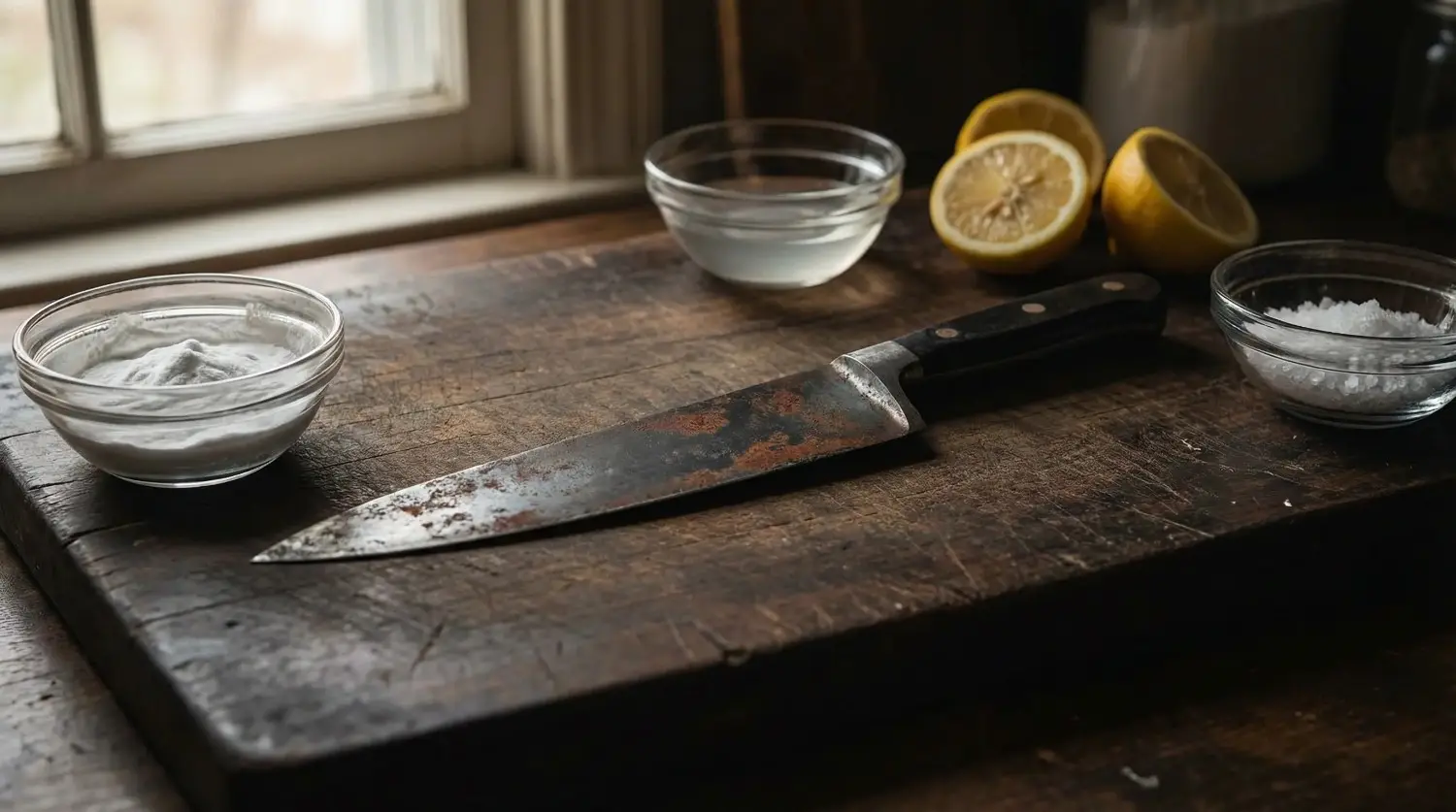

You reach for your favorite chef’s knife, and there it is — a reddish-brown patch creeping along the blade. That sinking feeling is familiar to every home cook and professional chef alike. But before you toss it in the trash, stop. Rust on a knive is not a death sentence for your blade.
The good news? Most rusty knives can be fully restored with simple household ingredients you already own. If you have been searching for how to remove rust from knives, you are in the right place. In this guide, you will learn seven proven methods — from a quick baking soda paste for rust removal to a white vinegar soak — plus the prevention habits that keep blades clean rust-free for life. One important thing to know upfront: carbon steel and stainless steel knives respond differently to rust and to rust removal. Knowing your blade type will help you choose the right method every time.
Why Do Knives Rust?
Knife rust forms when iron in the steel reacts with oxygen and moisture. This chemical reaction produces iron oxide — what we commonly call rust. It is a completely natural process, but it is also entirely preventable.
Carbon steel knives rust significantly faster than stainless steel knives because they contain little to no chromium. Chromium is the element in stainless steel that forms a protective barrier against oxidation. Without it, carbon steel is highly reactive — especially in a kitchen environment.
Several everyday factors speed up knive rust:
- Acidic foods like citrus, tomatoes, and onions react with the blade surface
- Dishwashers expose knives to prolonged heat, moisture, and harsh detergents
- Wet storage — leaving a knife damp on a counter or in a drawer — accelerates corrosion fast
Not all rust is equal. Here is how to read what you are dealing with:
- Surface patina — A dark, grayish discoloration on carbon steel. This is actually protective, not harmful.
- Light rust — Small orange or reddish rust spots that sit on the surface. Easiest to treat.
- Deep pitting — Rust that has eaten into the steel. Harder to remove the rust and may affect performance.
Identifying your rust level before you start saves time and protects your blade.
Can a Rusty Knife Be Saved?
In almost every case — yes. A rusted knife can be saved. The key is knowing how far the rust has progressed.
Light rust on a knife is always salvageable. A few minutes with baking soda, lemon, or a rust eraser for knives will have the blade looking clean again. If you are wondering how do you get rust off a knife with minimal effort, light rust is where household methods shine brightest.
Heavy rust and pitting takes more effort. The rusted blades can usually be restored, but deep pitting may leave permanent marks and slightly affect cutting performance. That said, the knife is still usable and worth saving in most cases.
Before you start, run through this quick checklist:
- Is the blade structurally intact with no cracks or breaks?
- Is the edge still viable — no major chips or warping?
- Is the handle firmly attached and undamaged?
- Is the rust limited to the surface rather than deeply pitted throughout?
If you answered yes to all four, your knife is absolutely worth restoring. If the blade is cracked, severely warped, or the rust has compromised more than half the steel, replacement may be the smarter call.
What You Will Need Before You Start
Getting organized before you begin makes the process faster and safer. Here is what you need:
Tools and Materials:
- Soft cloths or microfiber towels
- Old toothbrush or soft-bristled brush
- Non-metallic scouring pad or soft sponge
- Dish soap and warm water
- Your chosen rust removal knife treatment agent (covered in Section 4)
Safety First: Always handle a sharp blade with care during cleaning. Work slowly and deliberately — scrubbing rust off a knife means your hands are close to a sharp edge. Consider wrapping the spine of the blade with a folded cloth for grip control. Work on a stable, flat surface and never rush.
What NOT to Use:
- Steel wool — Too abrasive. It scratches the blade surface and can leave behind metal particles that cause new rust spots.
- Bleach — Corrosive to steel and toxic on food-contact surfaces.
- Harsh chemical degreasers — Not food-safe and can damage the blade finish permanently.
7 Methods to Remove Rust from Knives
Method 1: Baking Soda Paste
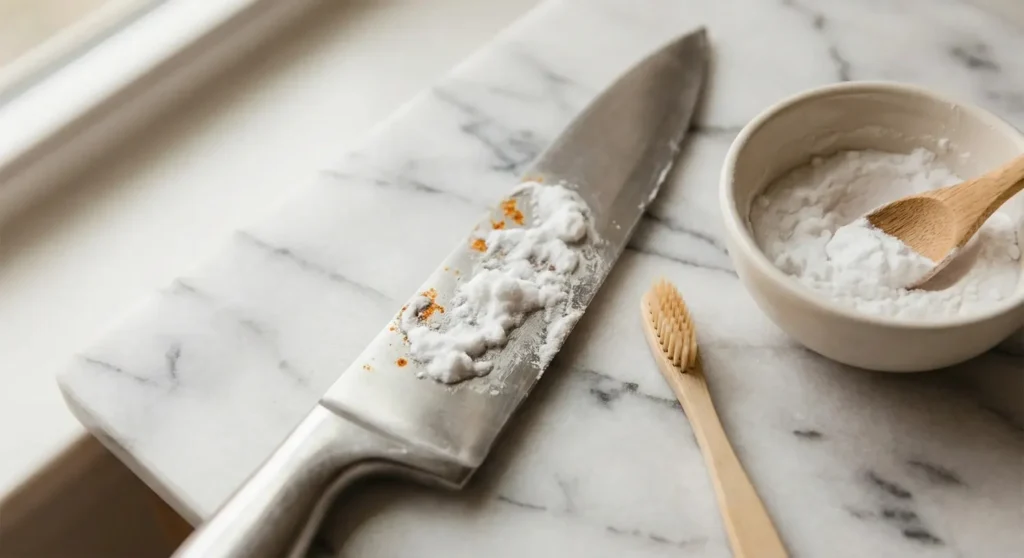
Best for: Light rust | Difficulty: Easy | Works on: All knife types
Baking soda is one of the most effective and safest ways to remove rust from a knife. Its mild abrasiveness lifts oxidation while its alkaline nature neutralizes the acidic rust compounds — without damaging the steel. It is the go-to solution when people ask how to remove rust from knives with baking soda, and for good reason.
Materials: Baking soda, water, soft cloth, toothbrush
Steps:
- Mix baking soda with a small amount of water to form a thick paste. This baking soda paste for rust removal should be thick enough to cling to the blade.
- Apply the paste generously over all rust spots.
- Let it sit for 1–2 hours for best results.
- Scrub gently with a toothbrush or soft sponge using circular motions.
- Rinse with warm soap and water.
- Dry the blade completely with a soft towel — never air-dry.
Pro tip: For stubborn spots, mix baking soda with lemon juice instead of water for a fizzing, more aggressive baking soda clean rust paste. People often ask can baking soda remove rust — and the answer is a confident yes. It also works similarly to how battery corrosion baking soda treatments work — the alkaline properties neutralize acidic corrosion on contact. Baking soda for rust stains is reliable, food-safe, and gentle on all blade finishes. Baking soda for rust removal is one of the oldest and most trusted kitchen hacks for good reason.
Method 2: Lemon Juice and Salt
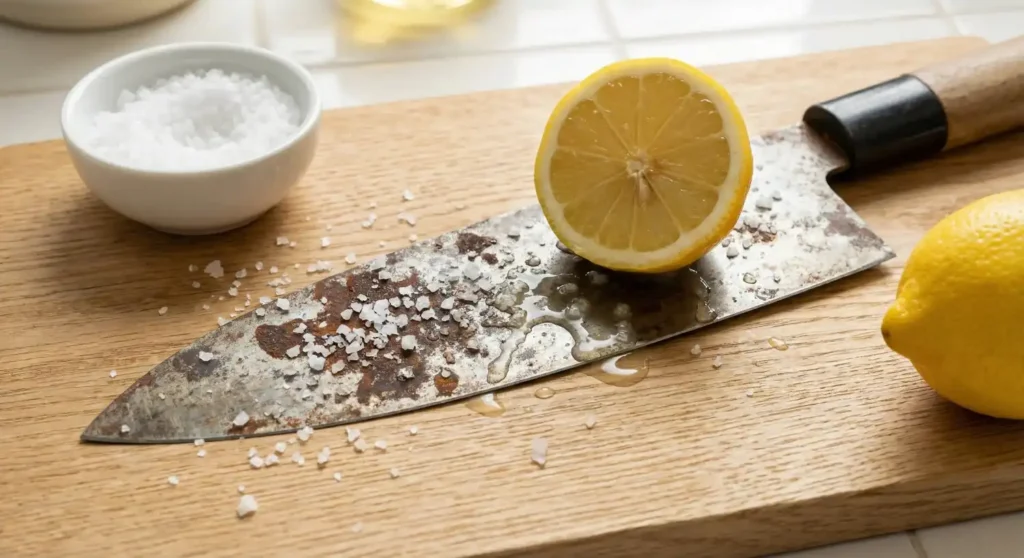
Best for: Surface rust | Difficulty: Easy | Works on: Stainless steel, light carbon steel rust
The citric acid in lemon juice dissolves iron oxide naturally, while coarse salt acts as a gentle abrasive to scrub it away. This all-natural method is ideal when learning how to clean a rusty knife without any special tools. It works exceptionally well for removing rust from a knife with light surface corrosion and is one of the easiest answers to how to get rid of rust on a knife.
Materials: Fresh lemon, coarse salt, soft sponge
Steps:
- Sprinkle coarse salt generously over the rust spots on the blade.
- Squeeze fresh lemon juice over the salt until fully saturated.
- Let it sit for 15–30 minutes. For carbon steel, keep it to 15 minutes maximum — acids can cause further staining with prolonged exposure.
- Scrub gently with a soft sponge, following the grain of the steel.
- Rinse thoroughly and wash with mild dish soap.
- Dry immediately and store in a dry place.
Method 3: White Vinegar Soak
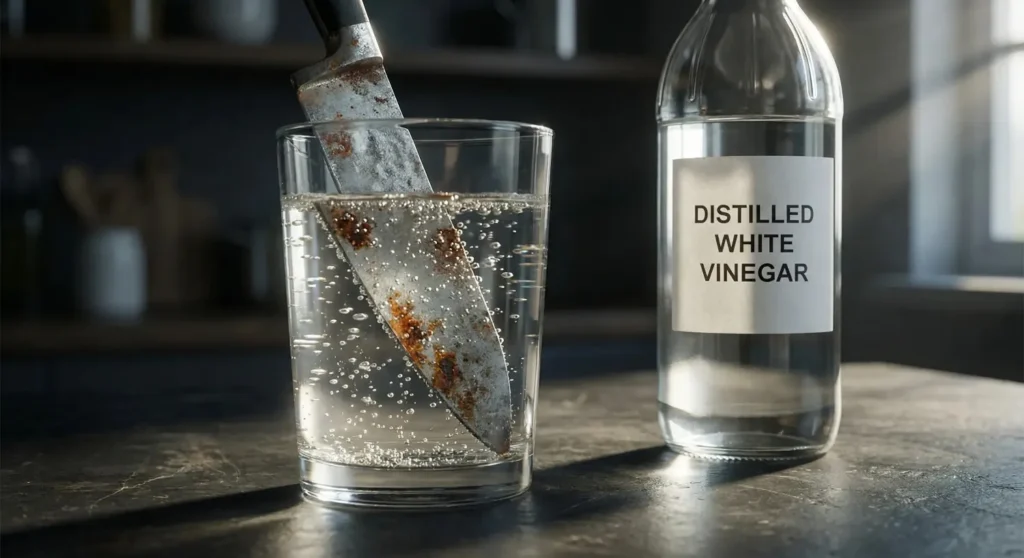
Best for: Moderate rust buildup | Difficulty: Easy | Works on: Stainless steel, moderate rust on carbon steel
White vinegar contains acetic acid, which reacts directly with iron oxide and breaks it down efficiently. It is one of the most popular methods to clean rust off knives because it is cheap, widely available, and remarkably effective. If you are searching for how to get rust off kitchen knives with a pantry staple, white vinegar is your best friend.
Materials: White vinegar (5% acidity), container, non-metallic scouring pad, dish soap
Steps:
- Pour enough white vinegar into a container to fully submerge the rusted section of the blade.
- Soak for 30 minutes to 2 hours depending on rust severity.
- Remove the knife and scrub with a non-metallic scouring pad.
- Rinse thoroughly with soap and water.
- Dry completely — moisture left on the blade after a vinegar soak can cause new rust spots quickly.
Warning: Do not soak carbon steel knives longer than 30–45 minutes. Extended acid exposure can etch the surface and dull the finish permanently.
Method 4: Rust Eraser / Whetstone Rubber Block
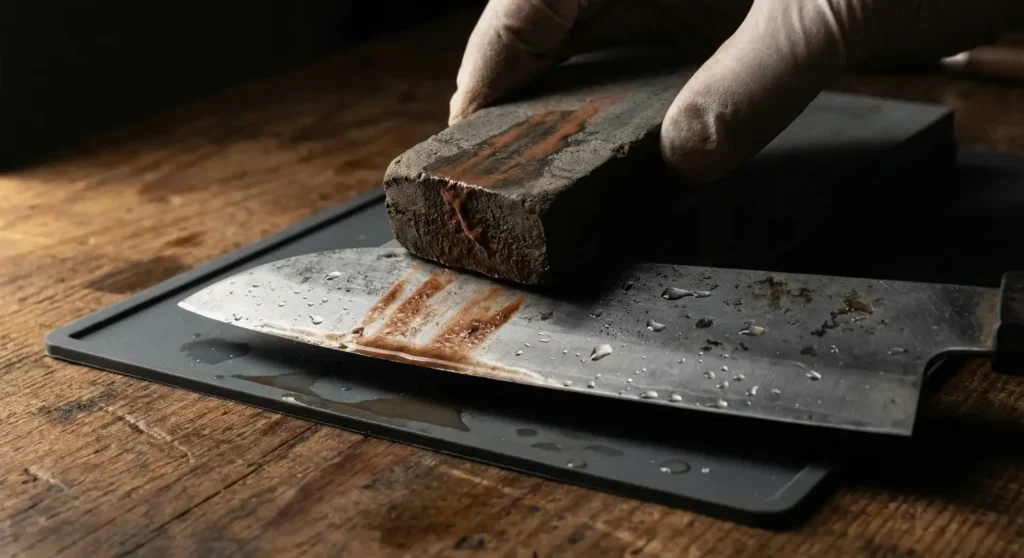
Best for: Persistent rust spots | Difficulty: Moderate | Works on: Carbon steel knives especially
A rust eraser for knives is a specialized tool made from rubber embedded with abrasive particles like silicon carbide. It targets rust stains with precision and is gentle enough not to damage the blade geometry — making it the professional’s preferred choice for carbon steel maintenance. This is the most precise way to remove rust from knife blade surfaces without risking damage to the surrounding steel.
Materials: Rust eraser, water
Steps:
- Soak the rust eraser for knives in water for 5 minutes.
- Rub the eraser firmly over rusted areas, always moving with the grain of the steel — never against it.
- Re-wet the eraser as it dries out during use.
- Once complete, rinse the knife, wash with dish soap, and dry thoroughly.
Rust erasers are inexpensive and reusable — a worthy addition to any serious knife care kit.
Method 5: The Potato Method
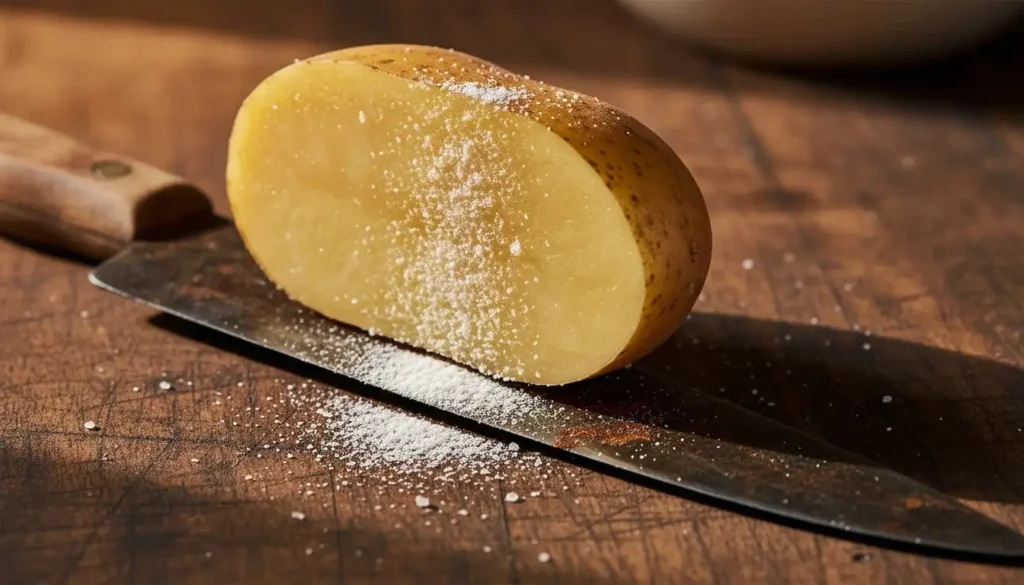
Best for: Light rust | Difficulty: Easy | Works on: All knife types, delicate finishes
The potato method sounds unusual, but it works. Raw potatoes contain oxalic acid — a mild organic compound that dissolves light rust without any harsh chemicals. It is completely food-safe and one of the most surprising answers to how do you remove rust from knives using nothing but your kitchen. The potato method is especially great for how to remove rust from kitchen utensils of all kinds, not just knives.
Materials: Raw potato, baking soda or coarse salt
Steps:
- Slice a raw potato in half.
- Dip the cut side into baking soda or coarse salt.
- Rub the potato firmly over the rusted areas using circular motions.
- Alternatively, insert the knife blade into a whole potato and leave it for 1–3 hours to let the oxalic acid work.
- Remove the knife, rinse thoroughly, wash with dish soap, and dry completely.
Method 6: Bar Keepers Friend
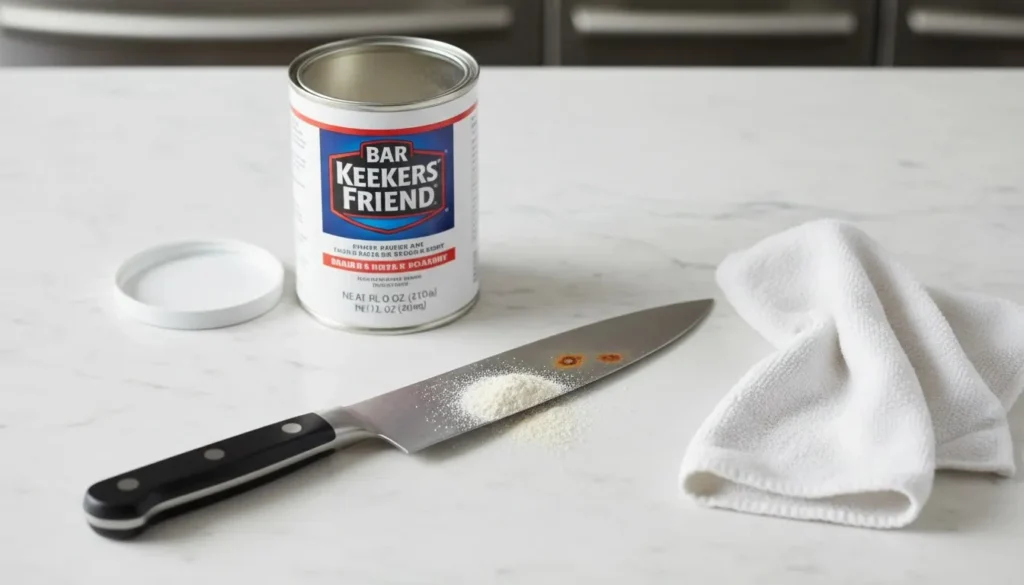
Best for: Stubborn rust stains | Difficulty: Easy | Works on: Stainless steel, tough rust stains
Bar Keepers Friend is a powdered cleanser containing oxalic acid — the same compound found naturally in potatoes, but in a far more concentrated form. It is a household staple and one of the best commercial products to remove rust from kitchen knife blades safely. Also it answers the question of how to clean rust from a knife when natural methods are not strong enough. And it is food-safe when rinsed thoroughly and works beautifully on rust stains that other methods leave behind.
Materials: Bar Keepers Friend powder, water, soft cloth or sponge
Steps:
- Dampen the blade slightly with water.
- Sprinkle a small amount of Bar Keepers Friend directly onto the rust spots.
- Rub gently with a damp soft cloth or sponge, following the grain of the steel.
- Let it sit for 1 minute — do not leave it longer as it can affect the finish.
- Rinse very thoroughly with soap and water to remove all residue.
- Dry immediately and completely.
Method 7: Fine Sandpaper or Wet/Dry Abrasive Paper
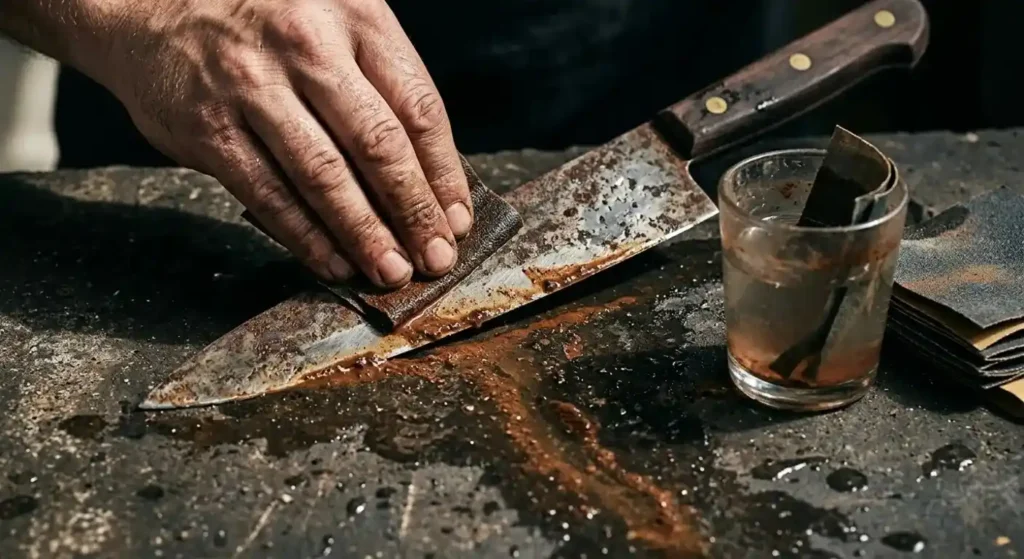
Best for: Heavy rust | Difficulty: Moderate–Advanced | Works on: Durable stainless steel blades with deep rust
When all other methods fall short, fine-grit sandpaper is your last resort before replacement. This method physically remove the rust layer from corroded steel and works on rusted blades with deep pitting. It is the most aggressive approach, but it is effective when you need to clean rust off knife surfaces that have deteriorated significantly.
Materials: 400–600 grit wet/dry sandpaper, water, dish soap
Steps:
- Wet the sandpaper with water to reduce scratching and keep the blade cool.
- Sand gently in one direction, always following the grain of the steel.
- Start with 400 grit for heavier rust, then finish with 600 grit to smooth the surface.
- Wipe away residue frequently to monitor progress.
- Once rust is gone, wash with soap and water and dry thoroughly.
- Apply a food-safe oil to protect the freshly exposed steel immediately after.
Chemicals to Avoid on Kitchen Knives
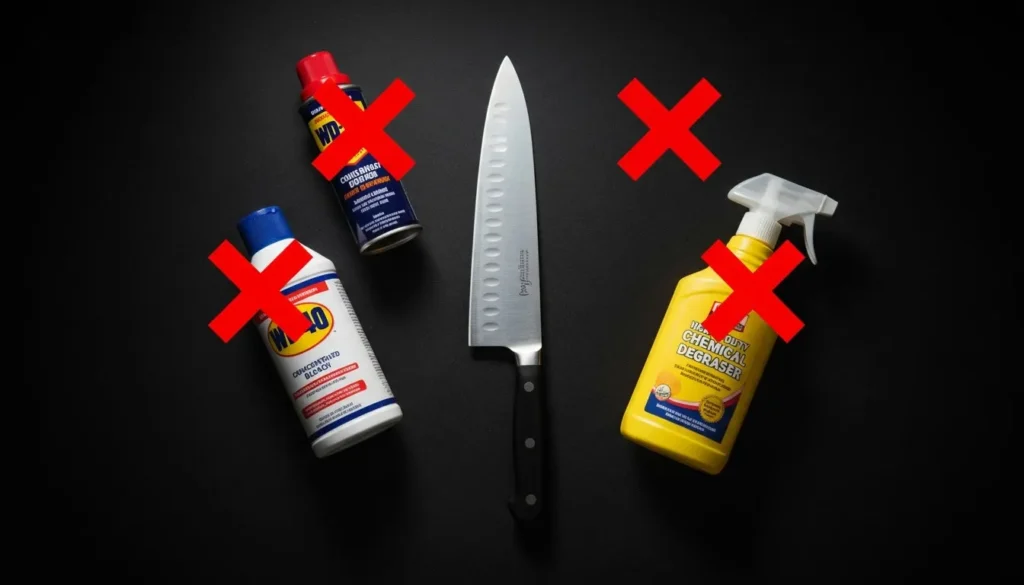
Not every rust remover belongs in your kitchen. Some products marketed for rust removal are genuinely dangerous on food-contact surfaces.
Avoid these entirely:
- WD-40 — Not food-safe. It leaves behind petroleum-based residue that is toxic if ingested, even after rinsing.
- Bleach — Highly corrosive to steel. It weakens the blade, damages the finish, and is dangerous on any surface that touches food.
- Harsh degreasers — Chemical solvents strip protective coatings and leave residues that contaminate food.
One nuance worth knowing: mild dish soap is perfectly safe and recommended for rinsing after every rust removal method. However, abrasive scrubbing powders that are not food-rated — even if they seem similar to Bar Keepers Friend — can damage the blade finish and should be avoided.
A simple rule: if you would not feel comfortable with it touching your food directly, do not use it on your knife.
How to Prevent Rust from Coming Back
Prevent rust before it starts. Removing rust stains is satisfying — never having to do it again is even better. These habits will keep your blades clean, sharp, and corrosion-free for years.
- Wash and dry immediately after every use. Never leave a knife wet on the counter or soaking in a sink.
- Never use the dishwasher. The heat, prolonged moisture, and harsh detergents are the fastest way to destroy both the blade and the handle.
- Store knives properly. A magnetic strip, knife block, or individual saya sheath keeps blades dry and protected. Avoid loose drawers where moisture collects.
- Oil your carbon steel knives. After cleaning, apply a thin coat of food-safe camellia oil or food-grade mineral oil along the blade. Do this after every use for carbon steel, and monthly for stainless steel. Camellia oil is the traditional Japanese choice — it is light, odorless, and deeply protective.
- Build a protective patina on carbon steel. A deliberate patina — a controlled, even oxidation layer — actually shields the steel from further reactive rust. You can force a patina by rubbing a sliced potato or apple along the blade and letting it oxidize naturally. The dark layer that forms is your blade’s armor.
Special Care by Knife Type
Different knives have different needs. Using the wrong method on the wrong blade can cause more harm than the rust itself.
Stainless Steel Knives The most forgiving type. Stainless steel resists rust well but is not immune — especially at the edge or near the handle. All seven methods work safely on stainless steel knives. If you notice rust on a stainless steel knife, it is usually surface-level and quick to fix. Learning how to get rust off of stainless steel knives is straightforward — a baking soda paste or white vinegar soak handles it in under an hour. Follow up with how to remove rust from stainless steel knives prevention steps: dry thoroughly after every wash and you will rarely deal with the problem again.
Carbon Steel Knives Highly reactive and the most rust-prone. Avoid soaking in vinegar or lemon for extended periods. Always oil after cleaning. Embrace the natural patina rather than fighting it — it is protective. The baking soda paste and rust eraser for knives methods are the safest for regular maintenance. Knowing how to get rust off of knives made from carbon steel correctly will save you from damaging a premium blade.
High-Carbon Japanese Knives The most reactive of all. How to clean rust off Damascus steel and other high-carbon Japanese alloys requires extra gentleness — use the rust eraser for knives or baking soda paste exclusively. Avoid all acid-based soaks. Oil with camellia oil after every single use. How to get rust off a knife of this caliber is about patience and the right tools — never force or rush the process.
Pocket Knives and Folding Knives The pivot point and folding mechanism are where moisture hides. How to remove rust from a pocket knife requires special attention to the joint area — use a toothbrush dipped in baking soda paste to work into tight spaces. Dry the pivot point thoroughly and apply a small drop of food-safe oil to keep it protected. How to get rust off knife hinges is about persistence and a small, precise tool.
Conclusion
A little rust does not make a knife worthless — it makes it a blade that needs some attention. Here is the quick recap:
- Light rust? Reach for baking soda paste for rust removal, lemon and salt, or the potato method.
- Moderate rust? A white vinegar soak or Bar Keepers Friend will remove rust from knife blade effectively.
- Heavy rust? Use a rust eraser for knives or fine sandpaper as your last resort to remove rust from knives for good.
Whatever the level, prevention is always easier than restoration. Dry your blades, store them properly, oil your carbon steel, and you will rarely need to how to get rust off kitchen knives searches again.
Want to go deeper on blade care? Explore our sharpening guides, knife maintenance tips, and curated knife collections to keep every blade performing at its best. And for more kitchen tools that combine performance with sustainability, visit Best Eco Kitchen Tools — your go-to resource for smarter, greener kitchen choices.
Check Related Posts: Stainless vs Cast Iron | The 5 Best Stainless Steel Pans | Are Cast Iron Cookware Safe | Cast Iron Cookware: The Complete Beginner to Expert Guide | Cooking Utensil Holder
Frequently Asked Questions
What removes rust from knives?
Baking soda paste, white vinegar, lemon juice with salt, a rust eraser for knives, the potato method, Bar Keepers Friend, and fine sandpaper all effectively remove rust from knives depending on severity. The best method depends on how deep the rust spots are and what type of blade you have.
Does vinegar remove rust?
Yes. White vinegar contains acetic acid that dissolves iron oxide. Soak the blade for 30 minutes to 2 hours, then scrub with a non-metallic pad and rinse thoroughly with soap and water.
Can you restore rusted knives?
Absolutely. Light to moderate rusty knives are almost always fully restorable using household methods. Even heavily rusted blades can often be brought back with sandpaper or a rust eraser for knives.
What dissolves rust on steel?
Acids dissolve rust most effectively. White vinegar, lemon juice, and oxalic acid (found in Bar Keepers Friend and the potato method) all break down iron oxide chemically. Baking soda for rust works differently — through alkaline neutralization rather than acid dissolution.
Can WD-40 remove rust from knives?
WD-40 can loosen rust on tools, but it is not food-safe and should never be used on kitchen knives. Stick to food-safe methods like baking soda or white vinegar for any blade that touches food.
Will Dawn dish soap remove rust?
Dish soap alone will not remove rust from knife surfaces, but mild dish soap and warm soap and water are essential for rinsing after every rust removal treatment. It is safe, effective for general cleaning, and recommended after every method in this guide.