

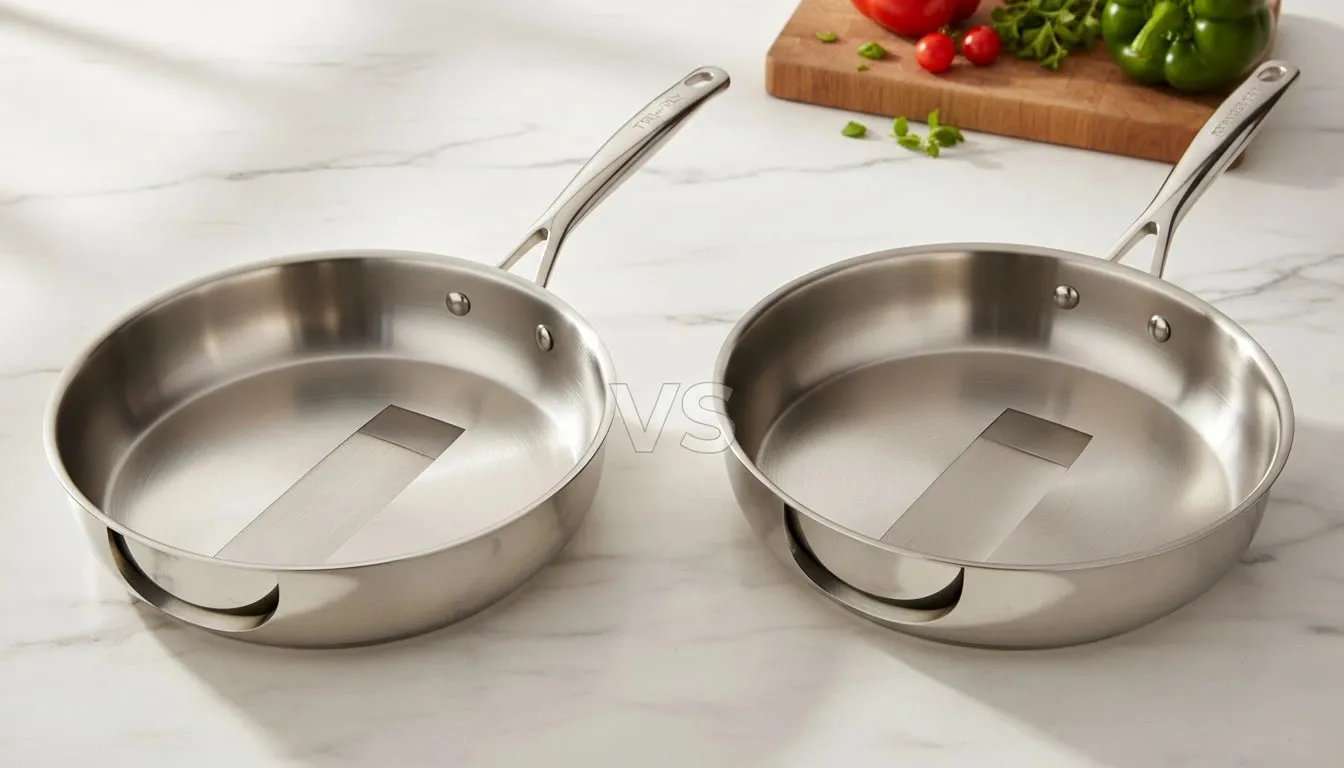

When shopping for new cookware, you’ve probably encountered terms like triply stainless steel and traditional stainless steel and wondered what the difference really means for your kitchen. The choice between triply vs stainless steel isn’t just about price—it fundamentally affects how your pans distribute heat, prevent hot spots, and deliver consistent cooking results.
Many home cooks struggle to understand whether tri ply stainless steel is worth the investment or if regular stainless steel pans will serve their needs just fine. The confusion is understandable, given that both options feature stainless steel cooking surfaces and look remarkably similar at first glance.
This comprehensive guide breaks down everything you need to know about triply vs stainless steel cookware. We’ll explore the multi layer construction that sets tri-ply apart, compare heat performance, and help you decide which type of cookware offers the best value for your everyday cooking needs.
Table of Contents
ToggleWhat is Stainless Steel Cookware?
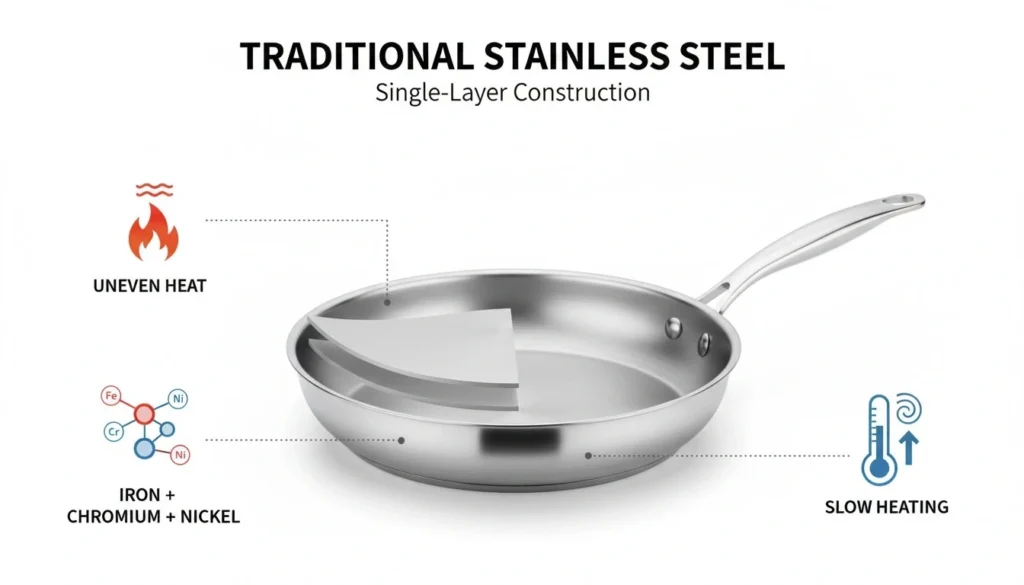
Traditional stainless steel cookware is made from a metal alloy combining iron, chromium, and nickel. The common grades you’ll see—18/10, 18/8, and 18/0—indicate the percentage of chromium and nickel in the mix. Stainless steel comes in different constructions: single-ply (one layer of stainless steel throughout) and disk-bottom (with a conductive base plate).
The challenge with pure stainless steel is its poor heat conductivity. Unlike aluminum or copper, stainless steel heats slowly and unevenly, creating hot spots where food burns while other areas remain cool. This uneven cooking happens because the metal struggles to distribute heat efficiently across the cooking surfaces, making temperature control difficult for home cooks during everyday cooking.
What is Triply (Tri-Ply) Cookware?
Triply stainless steel cookware represents a significant upgrade from traditional stainless steel through its innovative multi layer construction. Understanding what is tri ply stainless steel helps explain why it’s become the gold standard for serious home cooks.
The Three-Layer Construction
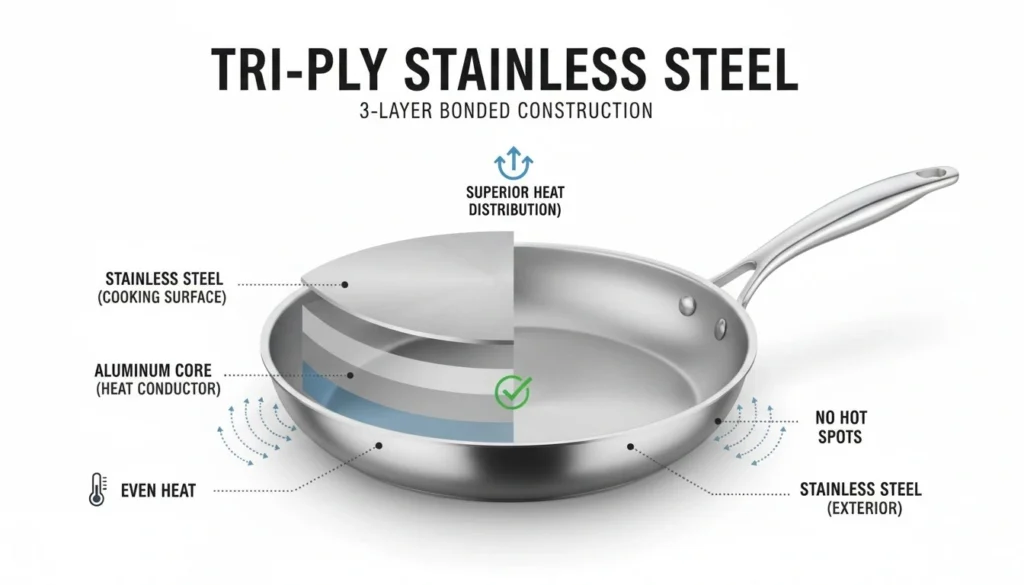
Triply stainless steel features three distinct bonded layers working together. The outer layer is magnetic stainless steel, providing durability and compatibility with all stovetops, including induction. The middle layer is an aluminum core (sometimes copper), which acts as the heat conductor. The innermost layer of stainless steel creates a non-reactive, food-safe cooking surface. These layers aren’t just stacked—they’re permanently bonded through high-pressure manufacturing, creating a single unified material that offers consistent performance.
Why the Aluminum Core Matters
The aluminum core is what makes triply cookware exceptional. Aluminum conducts heat approximately 15 times better than stainless steel, allowing triply pans to distribute heat evenly from edge to edge. This superior heat distribution eliminates hot spots that plague single-layer pans, ensuring your cooking results are consistent whether you’re searing in the center or sautéing near the rim. The responsive heat performance means temperature adjustments happen quickly, giving you precise control for everyday cooking.
Manufacturing Process
Tri ply clad cookware uses cladding technology where metal sheets are bonded under extreme pressure and heat. Quality 3 ply stainless steel cookware features full-clad construction, meaning the three layers extend up the sides of the tri ply pan, not just the base. Partial-clad or disk-bottom pans only have the aluminum core in the base, reducing effectiveness. Look for terms like “fully clad” or “clad throughout” when shopping for tri ply stainless cookware.
Triply vs Multi-Ply (5-ply, 7-ply)
Beyond 3 ply cookware, you’ll find 5-ply and 7-ply options. These add additional alternating layers of stainless steel and aluminum. However, for most home cooks, tri-ply provides optimal performance. The additional layers in 5-ply or 7-ply can improve heat retention slightly but often add unnecessary weight and cost. The jump from single-ply to tri ply is transformative; going beyond triply shows diminishing returns for everyday cooking unless you’re doing professional-level precision work.
Triply vs Stainless Steel: 7 Key Differences
Understanding the distinctions between triply vs stainless steel helps you make an informed cookware investment. Here are the seven critical differences that impact your cooking results.
1. Construction Method
Traditional stainless steel cookware uses a single material throughout or a disk welded to the bottom. Tri ply stainless steel, however, employs multi layer construction where three bonded layers work as one. The manufacturing complexity of tri-ply clad cookware requires precision engineering, while single-ply pans are simpler to produce. Quality variations are more pronounced in stainless steel pans, whereas 3 ply stainless steel cookware maintains consistency across reputable brands.
2. Heat Distribution
This is where triply vs stainless shows the most dramatic difference. Triply pans distribute heat uniformly across the entire cooking surface, while traditional stainless steel creates hot spots where the burner flame concentrates. Real-world testing shows triply frying pans brown foods evenly edge-to-edge, whereas single-ply pans burn in the center while edges remain undercooked. This superior heat distribution prevents uneven cooking that frustrates home cooks.
3. Heat Conductivity
Triply stainless steel heats faster thanks to its aluminum core. A triply pot reaches temperature 30-40% quicker than comparable single-ply cookware, improving energy efficiency. Temperature responsiveness is immediate with triply—when you reduce heat, the pan cools quickly. Traditional stainless steel lags significantly, making precision temperature control challenging during everyday cooking.
4. Heat Retention
Interestingly, ply stainless steel cookware with its multi layer construction retains heat longer than single-ply. The sandwiched layers create thermal mass that maintains cooking temperatures. This benefits braising and keeping food warm for serving, though it requires adjustment when recipes call for rapid temperature changes.
5. Weight Difference
Triply pans are noticeably heavier due to the aluminum core and multiple metal layers. A 12-inch tri ply frying pan typically weighs 3-4 pounds versus 2-2.5 pounds for single-ply. For home cooks with wrist concerns, this matters during hand wash and daily handling, though many find the improved heat performance worth the trade-off.
6. Price Point
Tri ply stainless cookware costs 50-200% more than basic stainless steel options. The complex cladding process, premium materials, and superior heat distribution justify the premium. 3 ply stainless steel pans represent an investment, but their durability and performance often make them cost-effective over years of everyday cooking.
7. Cooking Performance
Triply excels at precision cooking—delicate sauces, perfect sears, and controlled simmering. Professional chefs overwhelmingly prefer triply clad cookware for techniques requiring exact temperature control. Traditional stainless steel works adequately for boiling pasta or basic tasks but struggles with recipes where heat performance directly impacts results. The versatility cookware offers in triply construction makes it suitable for virtually any cooking technique.
Performance Comparison: Which Cooks Better?
Heat Distribution Test
When comparing triply vs stainless steel in real-world tests, the differences are striking. Tri ply stainless steel demonstrates exceptional even browning capability—pancakes and crepes color uniformly across the entire surface. Traditional stainless steel shows distinct hot spots where foods over-brown while edges remain pale.
Pan-frying tests reveal that triply pans maintain consistent temperatures, preventing burnt centers and undercooked edges. For simmering, triply stainless steel cookware maintains gentle, even bubbles throughout, while single-ply creates aggressive boiling in hot spots with dormant zones elsewhere. Testing shows superior heat distribution in 3 ply stainless steel cookware reduces uneven cooking by up to 80%, dramatically improving cooking results for home cooks tackling everyday cooking tasks.
Durability: Which Lasts Longer?
Longevity Expectations
Both triply stainless steel and traditional stainless steel offer exceptional lifespans when properly maintained. Quality triply stainless cookware typically lasts 20-30 years or more, with many manufacturers offering lifetime warranties. Single-ply stainless steel pans also endure decades, though warranties are often shorter (10-25 years). The multi layer construction of 3 ply stainless steel cookware doesn’t degrade over time—the bonded layers remain intact indefinitely. Long-term performance of triply remains consistent, while single-ply may develop more pronounced hot spots as bases warp slightly with age.
Resistance to Damage
Tri ply clad cookware demonstrates superior warping resistance due to its multi layer construction. The alternating metals create structural integrity that prevents the bottom from bowing on high heat. Traditional stainless steel, especially thinner gauge versions, warps more readily. Both types resist scratches well on their cooking surfaces, though metal utensils leave marks over time. Triply pans handle dents better—the aluminum core absorbs impact while outer layer stainless protects. Drops and bangs affect both types, but triply stainless steel maintains flat contact with burners better after minor accidents.
Corrosion and Rust
Neither stainless steel triply nor single-ply stainless rust under normal conditions. The chromium content protects both types. Pitting can occur with prolonged salt water exposure or leaving salty foods overnight, affecting both equally. Dishwasher safe claims apply to both, though many home cooks prefer hand wash to preserve appearance. Harsh dishwasher detergents can dull the finish on any stainless steel cookware, but don’t compromise the cooking surface integrity of either triply or traditional options.
Cost Comparison: Is Triply Worth the Extra Money?
The price gap between triply vs stainless steel is significant. A quality tri ply frying pan costs $80-$200, while comparable single-ply ranges $30-$80. Complete 3 ply cookware sets run $300-$800 versus $150-$300 for traditional stainless steel.
Triply stainless cookware costs more due to complex manufacturing—bonding multiple metal layers requires specialized equipment and precision. However, the investment pays dividends in heat performance. For home cooks doing frequent everyday cooking, triply stainless steel cookware eliminates uneven cooking and hot spots, improving cooking results substantially. The superior heat distribution and decades-long durability make tri-ply worthwhile for serious cooks, though budget-conscious buyers find traditional stainless steel adequate for basic tasks.
Triply Cookware: Pros and Cons
Advantages of Triply
Superior heat distribution – The aluminum core in tri ply stainless steel ensures heat spreads evenly across the entire cooking surface, delivering consistent cooking results that home cooks appreciate.
No hot spots – Unlike traditional stainless steel, triply pans eliminate burning in the center while edges stay cool, preventing uneven cooking during everyday cooking.
Better temperature control – Tri-ply cookware responds immediately to heat adjustments, giving you precision control for delicate sauces and searing.
Professional-quality results – The heat performance of 3 ply stainless steel cookware matches what professional chefs use, elevating your cooking results.
Energy efficient – Triply stainless steel cookware heats faster than single-ply, reducing cooking time and energy consumption for everyday cooking tasks.
Disadvantages of Triply
Higher price point – Tri ply stainless cookware costs significantly more than traditional stainless steel, with tri ply frying pans often double or triple the price of single-ply alternatives.
Heavier weight – The multi layer construction makes triply pans noticeably heavier, which can be challenging during hand wash or for cooks with wrist issues.
More expensive to replace – When a tri ply pot or pan wears out or gets damaged, replacement costs are substantially higher than basic stainless steel options.
Stainless Steel Cookware: Pros and Cons
Advantages of Stainless Steel
- More affordable – Traditional stainless steel cookware costs 50-70% less than triply stainless steel, making it accessible for budget-conscious home cooks starting their kitchen collection.
- Widely available – You’ll find stainless steel pans everywhere from discount stores to premium retailers, offering countless options for everyday cooking needs.
- Lighter weight – Single-ply pans weigh significantly less than triply pans, making them easier to handle during cooking and hand wash.
- Durable and long-lasting – Quality stainless steel cookware lasts decades with proper care, providing reliable cooking surfaces for years of use.
- Dishwasher safe – Most stainless steel pans are dishwasher safe, though many cooks prefer hand wash to maintain their appearance and longevity.
Disadvantages of Stainless Steel
- Uneven heat distribution (single-ply) – Traditional stainless steel struggles to distribute heat evenly, creating frustrating temperature variations across cooking surfaces.
- Hot spots common – Single-ply construction creates hot spots where food burns while other areas undercook, leading to uneven cooking that affects cooking results.
- Steeper learning curve – Managing hot spots and preventing sticking requires technique and experience that home cooks must develop through trial and error during everyday cooking.
Triply vs Stainless Steel: Which Should You Choose?
Choose Triply If:
- You cook frequently – If you’re preparing meals 4+ times weekly, the superior heat distribution of tri ply stainless steel significantly improves your everyday cooking experience and cooking results.
- Precision matters – Making delicate sauces, perfect sears, or temperature-sensitive dishes requires the heat performance that triply stainless steel cookware delivers without hot spots.
- You’re investing long-term – 3 ply stainless steel cookware lasts decades and the multi layer construction maintains consistent performance, making it worthwhile for serious home cooks.
- You cook on induction – Most triply pans work flawlessly on induction cooktops, providing the even heating that cookware offers across all stovetop types.
- You want professional results – The aluminum core in tri-ply clad cookware eliminates uneven cooking, delivering restaurant-quality performance at home.
Choose Stainless Steel If:
- Budget is your priority – Traditional stainless steel provides durable cooking surfaces at a fraction of the cost, suitable for occasional cooking needs.
- You’re just starting out – Single-ply stainless steel lets beginners learn cooking techniques without major investment before upgrading to triply vs stainless premium options.
- Weight concerns exist – Lighter single-ply pans are easier to handle for those with wrist issues or who prefer less hefty cookware during hand wash and cooking.
Why Trust Best Eco Kitchen Tools?
At Best Eco Kitchen Tools, we’re passionate home cooks dedicated to testing cookware in real kitchen conditions. Our team rigorously evaluates triply stainless steel, traditional stainless steel, and eco-friendly options through months of everyday cooking. We assess heat distribution, hot spots, durability, and actual cooking results across various techniques—from searing to simmering.
Every triply pan and stainless steel piece undergoes side-by-side testing to measure heat performance objectively. With over 8 years of reviewing cookware and testing hundreds of pieces, we provide honest, experience-based recommendations to help you choose the best cookware that offers both performance and sustainability for your kitchen.
Check Related Posts: Beeswax Wrapping Paper | How to Store Beeswax Wraps | How Long Do Beeswax Wraps Last | 6 Best Cast Iron Cookware Set
Frequently Ask Question
What are the disadvantages of tri ply stainless steel?
Tri ply stainless steel cookware is heavier and more expensive than regular stainless steel, and it may discolor or require proper maintenance to keep its shine.
Which is better, Triply or Tristeel?
Triply is generally better due to its aluminum core for even heat distribution, while Tristeel may vary by brand and construction quality.
Is triply Kadai good or bad?
A triply Kadai is good for everyday cooking as it offers even heat, prevents hot spots, and improves cooking performance.
Which material is not recommended for kitchens?
Low-quality aluminum without coating and cheap non-stick with harmful chemicals are not recommended for safe, long-term kitchen use.
Why avoid stainless steel cookware?
Some avoid stainless steel because food can stick without proper oiling and preheating, but high-quality versions are durable and safe.