

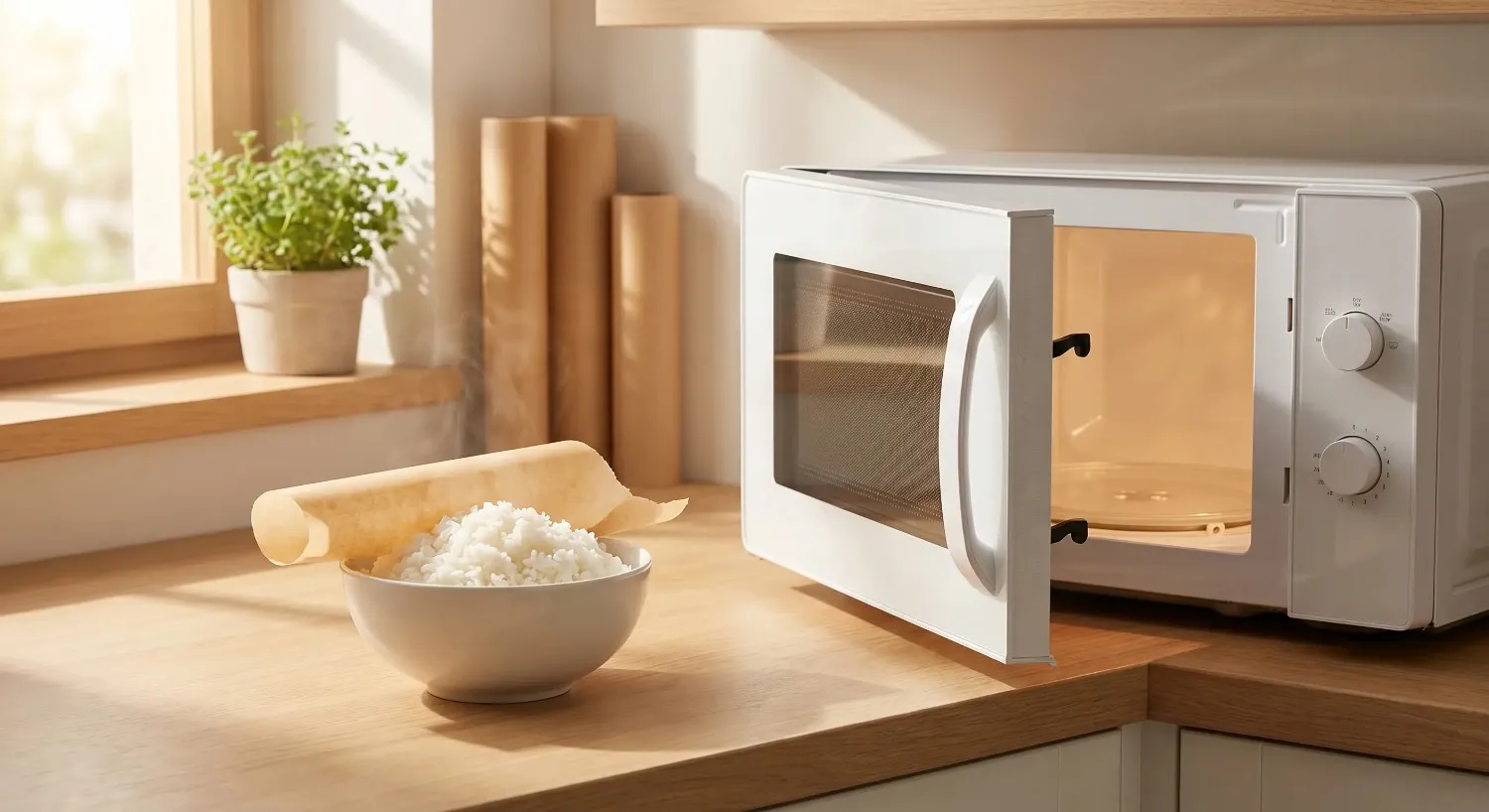

I’ll be honest — I didn’t think twice about this for years. I’d throw parchment paper in the microwave, cover my leftovers, heat them up, and move on. Then a friend told me she’d heard it could release toxic chemicals, and suddenly I was second-guessing every reheating session I’d ever had.
So I actually looked into it. Tested a few things. Read more government documents than any reasonable person should. And here’s everything I found out.
What is parchment paper, and how does it work?
Most people think of parchment paper as just that crinkly baking sheet stuff. But there’s more going on than that.
Parchment paper is made from cellulose fibers — basically wood pulp — that gets treated with sulfuric acid in a process called parchmentizing. That acid bath changes the structure of the paper at a molecular level, making it denser, more resistant to moisture, and able to handle heat that would destroy regular paper. After that treatment, most modern parchment gets a thin silicone coating on the surface, which is what gives it that signature non-stick quality.
That silicone-coated parchment is the kind you’ll find in almost every grocery store. It’s food-safe, heat-resistant, and genuinely useful beyond just baking cookies.
Now, here’s a distinction that trips people up: bleached vs unbleached parchment paper. White parchment paper has been treated with chlorine to get that clean look. Brown parchment paper hasn’t. Some people swear unbleached is safer. In practice, both are approved for food contact and both can handle microwave heat. The chlorine treatment in modern production leaves trace amounts so low they’re not considered a health risk by the FDA. I personally use unbleached out of habit, but it’s not a hill I’d die on.
One thing worth getting straight: baking paper vs parchment paper is basically a naming thing. In the US it’s parchment paper. In the UK and Australia, people call the same product baking paper. Same stuff. If you’re searching for microwave baking paper tips, you’re looking for the exact same information.
Can you microwave parchment paper?
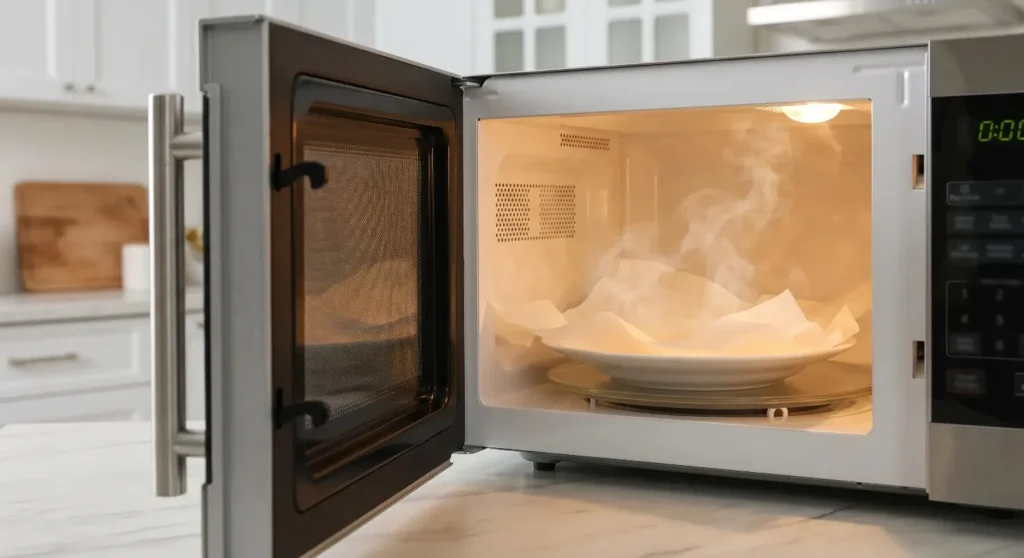
Yes. Parchment paper is microwave safe — with some conditions.
The short version: parchment paper in the microwave is fine for covering food, preventing splatter, or wrapping items to steam. It won’t melt, it won’t release dangerous fumes under normal circumstances, and it won’t catch fire in a standard heating scenario. The FDA regulates food contact substances including silicone-coated papers and requires they be safe for their intended use, which includes microwave applications. That said, “can you microwave parchment” isn’t a completely unconditional yes. Context matters.
Heat tolerance explained: what temperature does parchment paper burn?
Most parchment paper brands are rated to handle heat up to 420–450°F (about 215–230°C). Some premium brands push that to 500°F.
Food in a microwave almost never gets close to those temperatures during normal reheating. Water boils at 212°F, and most microwave heating keeps food in that range. So you’ve got a solid safety buffer. The only time parchment gets close to its limit is when you’re cooking something with a very high fat content — more on that in a second.
Why microwave heat is different from oven heat
This is something I haven’t seen explained anywhere, and it actually matters.
An oven heats from the outside in. The air around the paper gets hot first, which means the paper itself reaches high temperatures relatively quickly. A microwave works completely differently — it excites water molecules inside the food, heating from the inside out. The air inside your microwave stays close to room temperature. So the same piece of parchment paper experiences far less heat exposure in a microwave than it would in a 400°F oven, even if the food ends up at a similar temperature.
That’s good news for microwave parchment paper use. The paper genuinely runs cooler here than in baking.
Does microwave wattage affect parchment paper safety?
This is the question nobody’s answering, and it’s one I had after upgrading to a 1200W microwave a couple of years ago. My old one was 700W. The food cooks faster now, obviously — but I noticed the plate gets hotter too. Does that change anything for parchment paper microwavable use?
Short answer: a little, yes.
Low wattage (700W) vs high wattage (1200W+): does it matter?
At 700W, your microwave is relatively gentle. Food heats slowly and evenly. Parchment paper in a 700W microwave is about as low-risk as it gets.
At 1100–1200W, things move faster. Fatty foods like cheese, bacon, or sausages can reach higher localized temperatures more quickly, and the paper under or around those foods will absorb more of that heat. It still won’t hit the 420°F threshold in typical scenarios, but you should keep your heating times shorter and check on things.
My rule: anything over 1000W, I don’t run parchment paper in a microwave for more than 2–3 minutes at full power. For longer sessions, I either drop to medium power (around 50–70%) or switch to a microwave-safe glass lid.
Safe power level settings to use with parchment paper
For most standard reheating, full power is fine for short bursts under 2 minutes. For longer heating — say, steaming vegetables or defrosting — medium power (50–70%) is a smarter choice. It reduces the risk of hot spots and keeps your microwave-safe parchment paper well within its heat tolerance range the whole time.
Is microwaving parchment paper safe for your health?
This is the real anxiety behind the question, isn’t it? Nobody’s scared the paper will combust — they’re scared it’ll quietly leach something gross into their food.
Let me break down the actual concerns.
PFAS chemicals in parchment paper: what the research actually says
PFAS (per- and polyfluoroalkyl substances) are a class of synthetic chemicals that have been linked to health problems at high exposure levels. They’ve been found in some food packaging — including certain parchment paper products.
Here’s the honest picture: older and cheaper baking papers were more likely to use PFAS-based coatings. Most major brands have moved away from this. In fact, the FDA confirmed in early 2024 that PFAS-containing grease-proofing agents are no longer being sold into the US market for food packaging use — a voluntary phase-out backed by regulatory pressure. A Toxic-Free Future study found that rolls of parchment paper specifically tested negative for elevated fluorine levels, suggesting consumer parchment paper is among the lower-risk food packaging categories.
The risk from using mainstream parchment paper today is considered low. But if you’re using a cheap off-brand product without clear labeling, I’d be more cautious.
Dioxin and bleached parchment: separating myth from evidence
The dioxin concern about bleached white parchment paper has been floating around natural health circles for a long time. The theory: chlorine bleaching produces dioxin residue that migrates into food when heated.
The reality is more nuanced. Modern chlorine-free bleaching processes have largely replaced older methods for food-grade paper. Even older chlorine bleaching left residue levels far below any threshold considered harmful. The WHO’s fact sheet on dioxins acknowledges that current normal background exposure is not expected to affect human health, and that food packaging represents a negligible source compared to dietary exposure through contaminated food. Routine use of bleached parchment paper doesn’t come close to concerning levels.
If you’re still worried, just use brown parchment paper. Problem solved.
Quilon-coated vs silicone-coated: which is safer to microwave?
This one surprised me when I first came across it.
Some older parchment paper products use a coating called Quilon — a chrome-based complex. When heated, Quilon can break down and there’s ongoing debate about whether this poses a health risk. Most consumer parchment sold today uses silicone coating instead, which is inert, food-safe, and stable at microwave temperatures.
The label will usually say. If it just says “non-stick coating” with no further detail and there’s no mention of silicone, I’d pass on it. Silicone-coated parchment is the standard now, and it’s what you want for microwave parchment paper use.
Which parchment paper brands are microwave-safe?
Nobody answers this, and it drives me crazy. You’ll read five articles about whether parchment paper is microwave safe and not a single one will tell you which brand to actually buy. Here’s my take.
Reynolds vs If You Care vs Kirkland: microwave safety compared
Reynolds parchment paper is probably the most widely available in the US. It’s clearly labeled microwave safe parchment paper, uses a silicone coating, and has no PFAS. Reliable, affordable, works exactly as expected. Not exciting, but I’ve been using it for years without issue.
If You Care is the brand I’d reach for if health is your main priority. Independent lab testing by Mamavation found If You Care parchment paper returned a non-detect result for fluorine — meaning no detectable PFAS. They use a totally chlorine-free process and are transparent about their materials. It’s more expensive, but if you’re the type to read ingredient labels on everything, this is your parchment paper microwave safe pick.
Kirkland (Costco) is surprisingly solid for everyday use. It’s silicone-coated, handles high heat well, and comes in a massive roll that lasts forever. I’ve used it specifically for microwave baking paper purposes — covering casserole dishes, wrapping fish — and it performs exactly like the name brands at a fraction of the cost.
How to read the microwave-safe label (and what it really means)
The microwave safe label on parchment paper can appear as text, a small microwave icon, or three wavy horizontal lines. That symbol means the manufacturer tested it for microwave use. No symbol? Check the manufacturer’s website or don’t risk it.
“Oven-safe” does not mean microwave safe parchment paper. Oven heat and microwave radiation stress materials differently. A product can handle 400°F dry oven heat and still not be suitable for microwave use because of how moisture interacts with its coating.
PFAS-free parchment paper brands worth buying
Beyond If You Care, look for brands that explicitly state “PFAS-free” or “PFC-free” on the packaging. For parchment paper microwavable use, PFAS-free options give you the cleanest profile, especially if you’re reheating acidic foods like tomato sauce that can accelerate any chemical migration. The Consumer Reports investigation into PFAS in food packaging is worth reading if you want the full picture on how these chemicals end up in kitchen products.
How to safely use parchment paper in the microwave
The rules here are simple. Use parchment paper to cover food loosely — don’t seal it tight. You want steam to be able to escape. If you’re wrapping something, twist the ends rather than folding them flat against the food.
Keep the paper away from the microwave walls. A sheet that’s too large and touches the sides creates an uneven heat situation and could scorch in those corners. Cut it to size.
Don’t use it for long, high-power cooking cycles with fatty food. This is the one area where parchment paper in microwave use has a genuine risk. Bacon fat, rendered sausage grease, or cheese-heavy dishes can get extremely hot — hotter than the food itself registers — and at that point you’re pushing the paper toward its limits. Use a vented glass lid for bacon. Save parchment paper for lower-fat items.
And please, do not confuse it with wax paper. This matters. A lot.
Parchment paper in the microwave for specific foods
Reheating rice and pasta: This is where parchment paper in the microwave shines. Lay a piece loosely over your bowl. The paper traps just enough steam to rehydrate the food without it going soggy. Better results than plastic wrap, in my experience.
Steaming vegetables and fish: Wrap your fish or broccoli in a parchment pouch — the French call it en papillote — and microwave for 2–3 minutes. The steam builds inside and cooks it perfectly. I’ve done this with salmon and frozen vegetables more times than I can count.
Burritos and sandwiches: Wrapping a burrito in parchment paper for the microwave works well. It keeps the tortilla from getting rubbery and holds the whole thing together. Much cleaner than plastic wrap.
Microwave mug cakes and brownies: You can line a microwave-safe mug or container with parchment paper before adding batter. Makes cleanup trivial. Works especially well for sticky recipes.
Parchment paper vs other microwave covers: full comparison
Parchment paper vs wax paper in the microwave
This is not a close comparison. Can wax paper go in the microwave? Technically yes, for very short durations at low power — but it’s not something I’d recommend. Wax paper is coated with paraffin or soybean wax, and that coating melts at around 200°F. Your microwave will get there quickly. Once it starts melting, you get wax residue in your food and a mess to clean up.
Is wax paper microwave safe in the same way parchment is? No. Wax paper in the microwave is a liability. The question “can you microwave wax paper” comes up constantly, and the honest answer is: don’t bother. Use parchment paper instead. There’s no benefit to using wax paper for microwave heating when parchment paper does everything better.
Microwave wax paper situations where it might technically work: covering food for 30 seconds at medium power to prevent splatter. But honestly, a paper towel does that job just as well.
Parchment paper vs plastic wrap: which is safer?
Plastic wrap’s reputation has taken some hits, and not entirely without reason. Some older plastic wraps contained plasticizers like BPA that could migrate into food when heated. Most plastic wrap sold today is BPA-free, but the blanket recommendation to avoid plastic wrap in the microwave persists — and it’s not unreasonable.
Parchment paper has no such concerns. No plastic compounds, no chemical migration at normal temperatures, no debate. For microwave reheating, parchment paper is the more trusted choice. The trade-off is that plastic wrap seals food tighter, which can help with certain reheating scenarios. But the safety profile favors parchment.
Parchment paper vs microwave-safe lids
Lids are reusable, which makes them more economical and less wasteful over time. They’re better for deep bowls and containers with standard diameters. Parchment paper beats them for oddly shaped dishes, larger pots, or when you want a very loose cover that lets more steam escape. I keep both in my kitchen. Lids for everyday reheating, parchment for cooking and steaming applications.
Parchment paper vs paper towels
Can a paper towel go in the microwave? Yes, uncoated white paper towels are generally considered paper microwave safe for short use. They’re fine for covering food to prevent splatter for under 2 minutes. Beyond that, there’s a small fire risk if the towel dries out completely and contacts a hot surface.
Paper in a microwave more broadly — newspapers, brown paper bags, printed napkins — that’s where it gets dangerous. Inks, coatings, and the lower heat tolerance of unprocessed paper in the microwave make these risky. “Can paper go in the microwave” is a question worth being specific about. Plain paper towels and parchment paper: fine. Most other paper in a microwave: don’t.
When parchment paper is NOT microwave-safe: warning signs
Crumpled, heavily wrinkled, or already-used parchment paper is less predictable in the microwave. When the paper has been heated, torn, or deformed, hot spots form more easily. I never reuse parchment paper for microwave applications if it’s already been baked on or cooked with once. Just not worth the uncertainty.
If your parchment paper has no microwave-safe label and you can’t find the information on the manufacturer’s website, treat it as oven-only. Oven-safe doesn’t mean parchment paper microwave safe.
Any parchment paper that smells off when it’s heating, or turns brown or starts to smoke, pull it out. That shouldn’t happen at normal microwave temperatures, and if it is, something is wrong with either the paper or what’s on it.
Frequently asked questions
Can you put parchment paper in the microwave with foil?
No. Never put foil in the microwave, full stop. It doesn’t matter what’s next to it — parchment paper, food, anything. Metal and microwaves create arcing and can damage your appliance or start a fire. If a recipe calls for both, do the foil part in the oven.
How long can you microwave parchment paper safely?
For most standard reheating at full power, under 3 minutes is a safe range. For steaming applications at medium power, 4–5 minutes is fine. Beyond that, I’d monitor it. There’s no hard cutoff, but the longer and hotter the session, the more you’re asking of the paper.
Can I microwave a burrito in parchment paper?
Yep. Wrap it loosely, twist the ends, and microwave for 60–90 seconds. Works well. The parchment holds in enough steam to heat it evenly without making the tortilla rubbery.
What two things should you not put in a microwave?
Metal and sealed containers. Metal because of arcing. Sealed containers — including sealed plastic, sealed glass, or tightly wrapped food — because steam pressure builds with no escape, and things can explode. This is actually why you should never seal parchment paper too tight around food in the microwave.
Why did people stop using parchment?
Historically, “parchment” referred to animal skin — vellum — used for writing. When wood pulp paper became cheap and widely available, the animal-skin version became obsolete for everyday use. Modern parchment paper is a completely different product that just borrowed the name because the texture and finish are similar.