

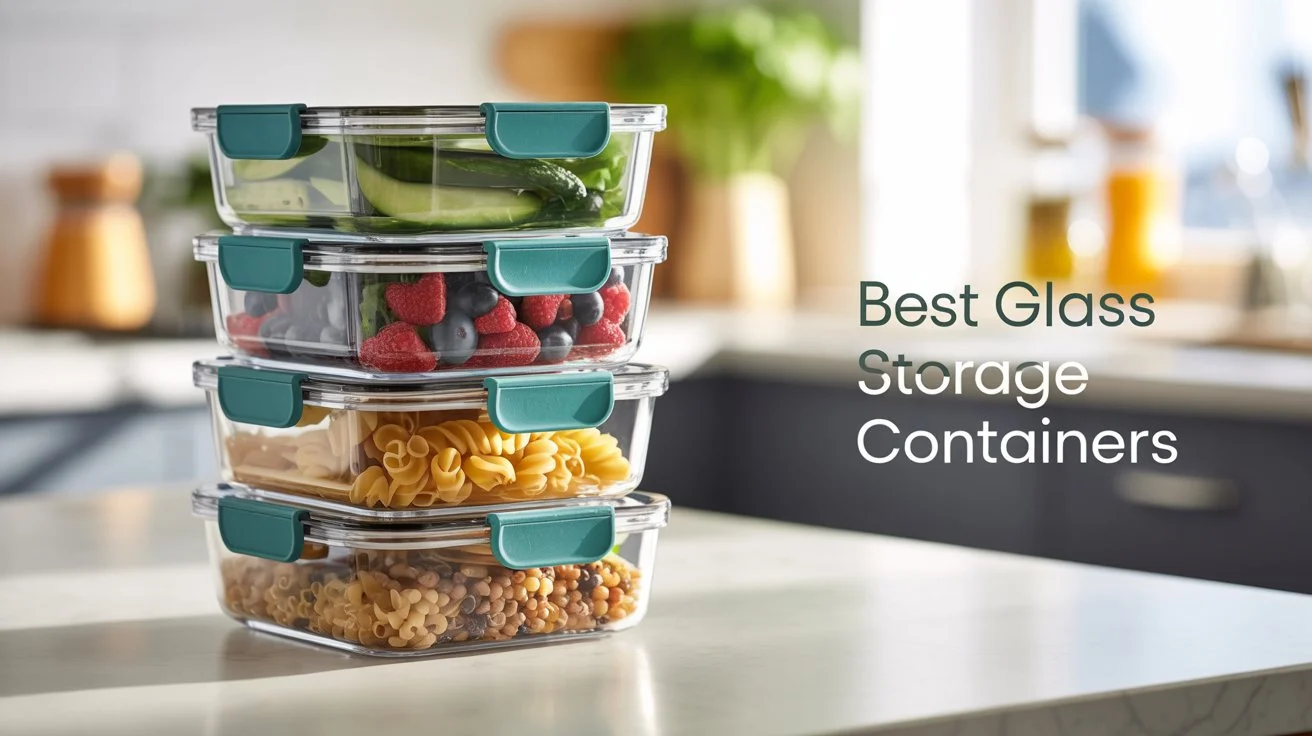

I’ve gone through a lot of kitchen storage phases. Plastic bins, mason jars, those flimsy takeout containers I kept washing and reusing until they turned yellow. Last year I finally committed to switching everything to glass, and after testing a handful of brands, Razab is the one that’s still sitting in my fridge right now.
This isn’t a sponsored post. I bought these with my own money after seeing them pop up repeatedly while searching for large glass food storage containers. Here’s everything I found out.
Table of Contents
ToggleQuick verdict: is Razab worth buying?
Short answer: yes, with one small learning curve you’ll get past in a day.
These are well-built glass food storage containers with lids that do exactly what they promise. The borosilicate glass is noticeably thicker than budget options I’ve tried. The lids actually seal. And unlike the cheap sets I wasted money on before, I haven’t had a single leak in six months of daily use.
Who this product is best for: Anyone switching away from plastic who wants containers they won’t have to replace every two years. Meal preppers, people who cook in bulk, anyone who’s tired of their fridge smelling like yesterday’s curry because the lid didn’t seal.
Rating at a glance:
- Durability: 9/10
- Lid quality: 8/10
- Value for money: 8/10
- Eco impact: 9/10
What is Razab? Brand background & credibility
Razab is a US-based family-owned business that started in 2017. They’re headquartered in New York, with offices in Texas and California. The brand claims their products are trusted by over 10 million American homes, and they’ve been featured in Food & Wine and Better Homes & Gardens.
Where the containers are actually made is something a lot of people ask about — and fairly. Razab is a US brand with US-based design and quality control. The glass itself is manufactured overseas, which is standard across basically every glass food storage containers brand at this price point, including Pyrex. What matters more is that their products are FDA food-contact compliant and BPA-free. I contacted their support to confirm this and got a clear answer within a day, which already puts them ahead of several competitors I’ve dealt with.
Family-owned also means something here. The customer service doesn’t feel like a call center script. When I had a question about lid replacements, I got a real response.
Product overview: what’s in the box
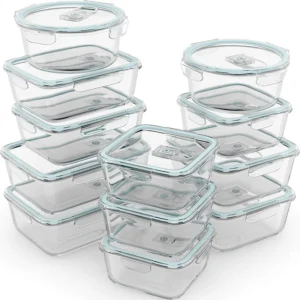
I tested the 1860ml / 63 oz set, which comes as a 2-container, 2-lid pack. That’s two large glass food storage containers that each hold 8 cups. Plenty of room for a full batch of pasta, a big salad, or a week’s worth of overnight oats.
Full Razab size range:
|
Set |
Capacity |
Pieces |
Best for |
|
840ml |
28 oz / 3.5 cups |
16-pc |
Portions, snacks |
|
1520ml |
52 oz / 6.5 cups |
4-pc |
Family sides |
|
1860ml |
63 oz / 8 cups |
4-pc |
Bulk storage |
|
3300ml |
112 oz / 14 cups |
2-pc |
Batch cooking |
|
6500ml |
220 oz / 28 cups |
2-pc |
Roasting, casseroles |
They also sell 24-piece and 35-piece sets with mixed sizes if you want to replace your entire cabinet in one go.
The locking lid uses a four-tab silicone mechanism. Each lid has four plastic flaps that clip down over the rim. Here’s what nobody tells you upfront: you have to close opposite flaps first, not adjacent ones. Close both sides on the same axis, then the other two. If you try to clip them in the wrong order, the lid bows and won’t seal flat. Took me two tries to figure that out. Once you know, it takes about three seconds.
Key features & specs (detailed breakdown)
Borosilicate glass — what it means vs standard soda-lime glass
Regular glass is soda-lime. It’s fine for drinking glasses, but it doesn’t handle temperature swings well. Pull a cold soda-lime container out of the freezer and put it in a hot oven and you’re asking for a crack.
Borosilicate glass has silica and boron trioxide in the mix, which makes it dramatically more resistant to thermal shock. That’s why it’s used in laboratory equipment and high-end cookware. Razab uses it throughout their line, which is not a given at this price. Some cheaper glass storage containers with lids on Amazon use standard glass and just don’t tell you.
The difference you feel in your hands is real. These containers feel dense and solid, not fragile. I’ve knocked mine against the sink a few times. Still intact.
Airtight silicone seal and four-tab locking lid — how to close correctly
The airtight glass storage containers for food function depends on the silicone gasket running along the inside of the lid. It creates a tight seal against the glass rim when the tabs are clipped down. The key thing: the silicone is removable for cleaning, which is something I actually appreciate. Pull it out, run it under hot water, put it back. No buildup.
To close correctly: press down on the lid so it sits flat on the glass. Clip the left flap, then the right. Then clip front and back. If it doesn’t click fully, the lid isn’t seated. Don’t force it. Lift it slightly, reseat, try again.
Temperature ratings: oven safe to 520°C (glass only), thermal shock to 248°F
The glass can handle up to 520°C in the oven. The lid for glass container is plastic with silicone — never put that in the oven or microwave. This is not unique to Razab. Every brand in this category works the same way. Store with the lid on, cook with the lid off.
Thermal shock resistance goes up to 248°F / 120°C differential. So going from a cold fridge directly to a preheated oven is fine. Going from a freezer to a screaming-hot stovetop is not. Use common sense.
Microwave, freezer, dishwasher safe — what’s allowed and what’s not
Glass microwave safe containers: yes. Remove the lid first. Glass freezer containers with lids: yes. Don’t fill them all the way to the top — liquids expand. Dishwasher: yes, top rack recommended.
Lid in the dishwasher: technically yes, but I hand-wash mine. The heat over time isn’t great for the plastic tabs, and lid replacements, while available, are annoying to source.
BPA-free, phthalate-free, FDA food-contact compliant
The containers are airtight food storage containers glass — no plastic touches your food at all. The lids are BPA-free and phthalate-free. FDA compliant across the range. If you’re switching to glass specifically because you’re worried about chemicals leaching into your food, Razab ticks all the boxes.
Rectangle/square shape — why it reduces dead fridge space
Round containers waste corners. The rectangle and square shapes in this line stack and pack tightly in the fridge with almost no wasted space. I reorganized my entire fridge shelf around two of these containers and gained back about a third of usable space. Small thing. Adds up.
Real-world performance: what we tested
Airtightness test — did liquids leak after 24 hours?
I filled one container with chicken broth, sealed it, turned it on its side, and left it in the fridge overnight. Zero leaks. I did the same with a cheaper set I had from Amazon and woke up to a shelf covered in broth. The airtight glass containers function on Razab is not marketing fluff — the silicone seal actually works.
Oven-to-fridge transition — thermal shock resistance in practice
Made a batch of roasted vegetables, pulled the container straight from a 400°F oven, and put it in the fridge after a five-minute rest. No cracking, no stress fractures. I won’t pretend I was confident the first time. I was hovering nearby. But it handled it without any drama, which is exactly what you want from freezer safe glass containers.
Dishwasher durability after 30+ washes
The glass looks identical to when I bought it. No clouding, no etching. The lids have a very slight dullness on the plastic after repeated dishwasher cycles, which is why I now hand-wash them. The glass itself goes in the dishwasher every time without issue.
Lid seal over time — does it stay airtight after repeated use?
Six months in, the seal is still solid. The silicone gasket hasn’t warped or shrunk. I’ve seen cheaper lids for glass storage containers start failing within two or three months. These haven’t. Could reach a point where the silicone needs replacing, but I’m not there yet.
What customers say: verified buyer reviews summary
Amazon rating and total review count
The 1860ml set sits at 4.6 out of 5 on Amazon with over 1,000 verified ratings. That’s a strong signal for a product at this price point.
The most repeated praise in the reviews: the glass quality feels premium, the seal actually works, and the rectangular shape is genuinely useful in a packed fridge. The most common complaint, and I agree with this one, is that the four-tab lid takes a few tries before it clicks in your muscle memory. A handful of reviewers mentioned the lids are harder to close than expected. That’s a fair criticism. It’s not a dealbreaker, but it gets old for about two days before you figure it out.
Razab vs competitors: how it stacks up
Razab vs Pyrex — glass quality and lid design
Pyrex has the name recognition, but the lids are the weak point. Pyrex’s standard plastic snap lids don’t have a silicone seal on most sets, which means the airtight containers glass function is inconsistent. Razab’s four-tab silicone system creates a tighter seal. For pure glass quality, they’re comparable. Razab often comes in at a lower price per container, especially in larger sets.
Razab vs OXO Good Grips — seal reliability
OXO makes good products. The Good Grips glass containers have a push-button locking lid that’s easier to figure out than Razab’s four-tab system. Seal quality is similar. OXO tends to run more expensive, and the size range isn’t as wide. If ease-of-lid is your top priority, OXO has an edge. If you want more size options and better value on larger containers, Razab wins.
Razab vs generic plastic containers — health and longevity
Not a fair fight. Glass food storage containers don’t stain, don’t absorb odors, and don’t leach chemicals. Plastic containers look fine for the first few months, then they start yellowing, cracking around the hinges, and smelling faintly of whatever you stored in them three months ago. The upfront cost of glass is higher. The replacement cost of plastic is higher over two years. Do the math.
Side-by-side comparison table
|
Feature |
Razab |
Pyrex |
OXO Good Grips |
|
Glass type |
Borosilicate |
Soda-lime (most lines) |
Borosilicate |
|
Airtight seal |
Silicone gasket |
Basic snap (varies) |
Silicone gasket |
|
Oven safe temp |
520°C |
450°F / 232°C |
425°F / 218°C |
|
Dishwasher safe |
Yes (top rack) |
Yes |
Yes |
|
Price per container |
$$ |
$$-$$$ |
$$$ |
Best use cases for Razab containers
Glass meal prep is where these shine. I prep on Sundays and these containers keep food fresh through Friday without any of the smell transfer you get with plastic. The larger sizes handle a full batch of grains or protein. The smaller sets from their 16-piece line are great for portioning.
They also work well for glass freezer safe containers use. I freeze soups and stews regularly. Leave an inch of headspace, and the containers handle freezing without cracking. Going from freezer to fridge overnight before reheating works perfectly.
For pantry organisation, the rectangular shapes stack beautifully. I’ve also used them for storing dry goods — flour, rice, the kind of stuff that used to live in their original bags taking up twice the space. I even keep a couple on the counter for things I grab daily. They look good enough that I don’t feel like I need to hide them.
Pros and cons
Pros
- Borosilicate glass throughout — noticeably more durable than budget competitors using soda-lime glass, and the thermal resistance is real
- Airtight silicone seal actually works — six months of daily use and zero leaks; the gasket hasn’t degraded
- Wide size range — 840ml to 6500ml means you can use these for everything from packed lunches to roasting a full turkey
- Multi-use design — oven, microwave, freezer, dishwasher all covered in one container (lid off for heat)
- BPA-free and FDA compliant — no chemicals touching your food, full stop
- Eco-friendly — glass is infinitely recyclable, and these will outlast any plastic set by years
Cons
- Heavier than plastic — if you’re packing a lunch bag, you’ll feel the difference; not a dealbreaker, but worth knowing
- The four-tab lid has a learning curve — two or three uses before it feels natural; the instructions don’t explain the order clearly enough
- Lid longevity in the dishwasher — the plastic tabs dull over time with repeated high-heat cycles; hand-washing extends their life significantly
- Higher upfront cost — a quality glass tupperware set like this costs more than a plastic set initially, even if it’s cheaper long-term
Where to buy Razab glass containers in the USA
Amazon is the easiest option. The full Razab lineup is available there, often with bundle pricing on multi-piece sets. The 1860ml 4-piece set typically runs in the $25–$35 range depending on timing. Check the “frequently bought together” section — the 24-piece best glass meal prep containers set occasionally goes on sale.
Walmart.com carries several Razab sizes, including the larger 6500ml container.
Razab.com is their direct store if you want the full product range in one place.
Final verdict
Razab makes some of the best glass food storage containers available at this price. The borosilicate glass is legitimately good. The seal works. The size range is wide enough to cover every kitchen use case from meal prep to batch freezing.
The lid takes a day to figure out. That’s the honest trade-off.
If you’re ready to stop buying plastic every 18 months and want airtight glass storage containers for food that actually keep things fresh, buy these. If you need the absolute simplest lid mechanism available and don’t mind paying more, look at OXO. Everyone else: Razab is the move.
Confidence score: 8.5/10.
Frequently Ask Qusetions
What is the best brand of glass storage containers?
For most people, Razab or OXO. Razab wins on value and size variety. OXO wins on lid simplicity. Pyrex is fine but lags on airtight sealing in most of their standard lines. If you want the best glass containers for food storage without overspending, Razab is the one I keep recommending.
What is Razab?
A US-based family business founded in 2017, headquartered in New York. They make glass food storage containers with lids, bakeware, and meal prep sets. Their products are FDA compliant, BPA-free, and sold primarily through Amazon, Walmart, and their own site.
Are glass storage containers good?
Really good, actually. They don’t absorb odors or stains, they’re safe in the oven and microwave without worrying about plastic leaching, and they last years longer than plastic. The only honest downside is weight.
What are the disadvantages of glass containers?
They’re heavier, they break if dropped hard enough, and they cost more upfront. That’s basically the full list. If those tradeoffs don’t bother you, there’s no good reason to keep using plastic for food storage.